

How Service Providers Use FDD to Become Trusted Advisors
September 30, 2026
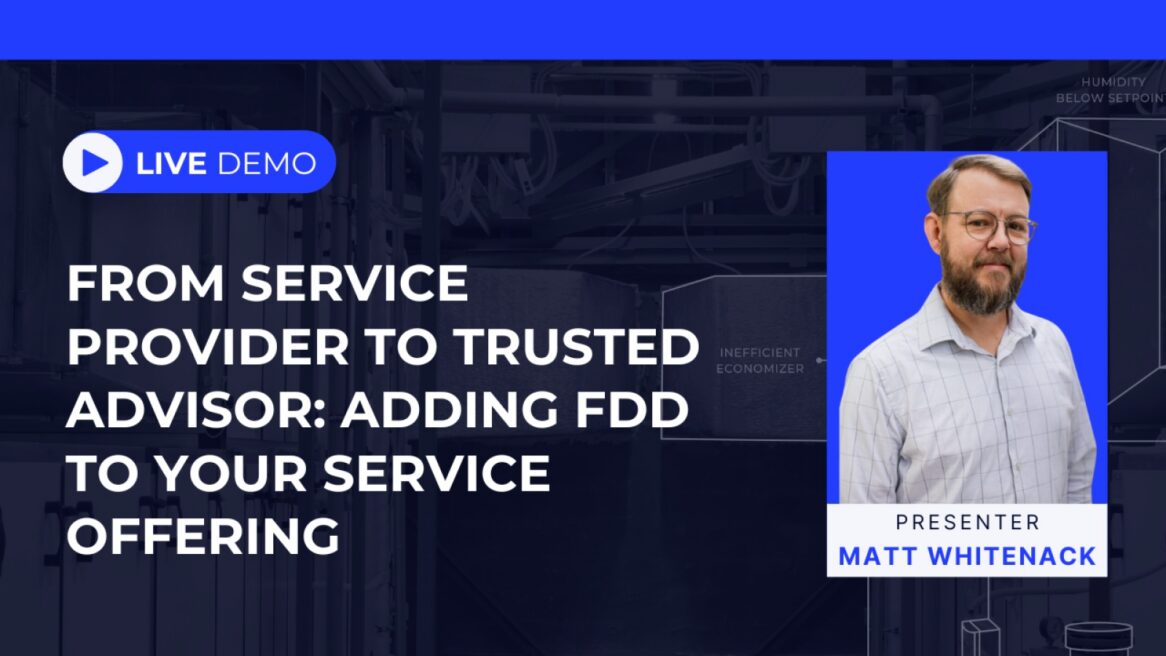
Adapted from Matt Whitenack’s Clockworks webinar, From Service Provider to Trusted Advisor.
Matt Whitenack spent years as a mechanical technician before he joined Clockworks. Today he works with the contractors in its partner program, and he put their biggest problem simply:
“Results have always been hard to quantify in the service business. People know you do something. They know that their equipment doesn’t break down.”
Watch this moment in the webinar — 47:06
That’s a hard story to tell at renewal time. In his webinar, Matt showed how service providers use fault detection and diagnostics (FDD) to go from vendor to trusted advisor. They find problems before the client does, fix them the first time, and show the client exactly what the service delivered.
Key takeaways
- FDD checks every piece of connected equipment every day, so it catches problems a technician standing in front of an air handler would never see.
- Each diagnostic comes with a root cause and a calculated cost, based on engineering data and the client’s utility rates. It isn’t an estimate.
- Technicians show up knowing the fix and carrying the parts, and the next day’s data shows whether the fix held.
- An impact report shows the client what the service delivered: tasks done, dollars saved, and the work still open.
Matt Whitenack’s full webinar, “From Service Provider to Trusted Advisor: Adding FDD to Your Service Offering.” The “watch this moment” links below jump this player to the point being quoted.
What does FDD change for service providers?
Matt’s job is to help Clockworks partners, mostly controls and mechanical contractors, move their service “from sort of a time and materials to more of a proactive approach.”
That’s what the partner program is for. It helps contractors use FDD to offer “a different level and a better level of service than their competition.” Clockworks has written before about FDD for mechanical and controls service and diagnostic-driven service contracts.
Finding problems is only half of it. Matt was clear about the other half:
“FDD is fantastic, but if nothing ever gets fixed, then it’s very difficult to transmit the value of those findings.”
Watch this moment in the webinar — 13:18
What can FDD see that a technician can’t?
Some problems are almost impossible to catch in person. Simultaneous heating and cooling is one of them.
“I spent many, many years as a mechanical technician, and I can’t tell you that I ever found one sitting on a bucket in front of an air handler.”
Watch this moment in the webinar — 33:32
Clockworks is “watching all the time,” Matt said. In the demo, it found “thirteen degrees of heat across a heating coil that should be closed.” Hot water was leaking past the valve, and the cooling coil had to take that heat back out.
Clockworks’ diagnostics “are aware of one another,” so the leaking valve showed up twice: as its own fault, and as the likely cause of the heating and cooling problem. Every diagnostic also comes with:
- A root cause. Why the problem is happening, in plain language.
- A calculated cost. What the problem cost yesterday, last week, or last month. Energy waste is only counted once, even when several faults are linked.
- Three priority scores. Energy, comfort, and maintenance. Maintenance covers anything that shortens equipment life. “Think of a short cycling compressor,” Matt said. It might not waste energy, but it has “a massive impact to the lifespan” of the equipment.
Someone in the audience asked if that cost is real money or an estimate. Matt’s answer: “It is a calculated energy waste amount. It is not an estimate.” It comes from engineering data and the client’s own utility rates.
How does a diagnostic turn into a fixed problem?
Every partner has a champion who runs the workflow. “They’re the quarterbacks,” Matt said.
The champion opens a diagnostic and reads an AI-written summary. Matt called it “one of our very constrained and conservative uses of large language model AI.” The summary lists the top actions and says whether each one is a mechanical fix or a controls fix.
One click creates a task. The champion splits it up by trade, sending the reset schedule to the controls team and the valve to the mechanical team, through the client’s work order system or by email.
“That technician would then go into the field armed with the parts they need.”
Watch this moment in the webinar — 37:54
The data checks the work, too. If the fault shows up again the next day, the fix didn’t hold. Clockworks calls this first-time fix rate, and the goal is to keep it high.
How does FDD change a service agreement?
“I see a huge shift in the marketplace from this sort of reactive putting out fires, checklist based PM schedules to a more condition based approach.”
Matt’s version of the rule: “Let’s not just change filters because it’s time to change filters.” A maintenance dashboard ranks equipment from red to green, so a technician can spend five minutes before a visit and know which units need attention first.
It can change the whole schedule. One partner used to do quarterly PMs. Now they do two on-site PMs and ten virtual PMs, where someone meets with the client online to walk through the diagnostics.
“It’s actually more touch points with your customer. It’s less time in a truck.”
Watch this moment in the webinar — 48:24
It also brings in project work. When FDD finds something costly that’s outside the contract, the contractor can bring it to the client. In Matt’s words, it lets you be “more of a consultant and less of a firefighter.” His advice for technicians is to start with the top three issues. “If you do the top three things, you will bring more value to that customer every time.”
How do you show a client what the service delivered?
At the end of an agreement, the impact report puts the year in one place: the buildings and equipment watched, the tasks completed, the energy dollars and carbon saved, and the tasks still open with what they’re worth. Matt called it “your ROI that you take to the customer at the end of your agreement.” That report is what turns a service provider into a trusted advisor.
Watch this moment in the webinar — 45:55
The open tasks start the next conversation. As Matt put it, “we need to talk about budgets for next year. We need to talk about a capital plan.”
A data quality report helps, too. It works as a quick health check on the client’s BMS, listing every point that’s dead, stale, or out of range. The team can fix what’s actually broken instead of taking what Matt called a “broad shotgun approach.”
Why can a client trust the numbers?
An impact report only works if the client believes it. Matt was direct about where that starts: “Analytics are based all around data, so we have to make sure that we have good quality data coming in so we can give you very good diagnostics coming out.”
Watch this moment in the webinar — 41:40
Clockworks also collects its own data. “We trend every point ourselves,” Matt said. Every piece of equipment sits in one information model, so the software knows what is upstream and downstream. That is why “we only count energy waste one time.” That model covers more than 650,000 connected assets and runs 50+ expert systems.
The model keeps growing, too. When Clockworks connects a piece of equipment it has never seen, the analysis team writes diagnostics for it, and “then it’s available to everybody.”
Watch this moment in the webinar — 52:58
What does it take to get started?
- A building automation system. Clockworks connects to most modern systems and doesn’t depend on the hardware on site.
- A small piece of software. Clockworks Edge runs on a supervisor or a virtual machine and sends five-minute data outbound only to Microsoft Azure. “We do not come back to the firewall with any command or control,” Matt said. There are no new boxes to install and no IP addresses for IT to manage, and a Clockworks team handles security questionnaires.
- What the contractor knows. Equipment schedules, written control sequences, and utility rates. “You guys are the experts in these facilities. We are the experts in FDD, so we have to work together.”
Onboarding starts with staging. The contractor connects Clockworks with the client’s IT team and gathers the equipment details. Go-live comes about 30 to 45 days later, with early diagnostics, and full diagnostics follow about 30 to 45 days after that.
Watch this moment in the webinar — 53:53
Then the relationship keeps going. Matt meets with each of his partners every two weeks. “It’s not a software sale,” he said. “It’s very much a relationship that we build.”
Watch the full webinar above. If you’re a mechanical or controls contractor, request a demo and ask for Matt, or learn more about the Clockworks partner program.
Frequently asked questions
What is FDD for service providers?
Fault detection and diagnostics (FDD) is software that watches a building’s automation data and finds equipment problems, their causes, and their cost. For mechanical and controls contractors, it turns a service agreement from reacting to breakdowns into finding and fixing problems before the client notices. It also gives them the data to show clients what the service delivered.
Is the avoidable cost from FDD real money or an estimate?
It’s a calculated amount, not an estimate. Clockworks uses engineering data from the equipment schedules and the client’s own utility rates to work out what each problem cost. Energy waste is only counted once, even when several faults are linked.
Does FDD replace scheduled PMs?
Not entirely, but it changes how they’re done. Technicians can see which equipment needs attention before a visit, and some partners have swapped part of their on-site PMs for virtual reviews. One partner moved from quarterly PMs to two on-site PMs and ten virtual ones.
How long does it take to get started with Clockworks?
Go-live, with early diagnostics, usually comes about 30 to 45 days after staging. Full diagnostics follow about 30 to 45 days after that. Staging is when the contractor connects Clockworks with the client’s IT team and gathers equipment schedules, control sequences, and utility rates.