

Deferred Maintenance in K-12 Schools Isn’t Just a Budget Problem. It’s a Data Problem.
April 9, 2026
For K–12 school districts across the country, deferred maintenance is often framed as an unavoidable financial reality. Aging buildings, shrinking budgets, expiring federal relief funds, lean teams, and growing operational demands all point to the same conclusion:
There simply isn’t enough money or human capital to fix everything.
But that misses an important truth: deferred maintenance isn’t just a budget problem. It’s a data problem.
The Hidden Cost of Guesswork in K–12 Facilities
Most school districts know what they’re up against:
- Buildings that are 40, 50, even 60+ years old
- HVAC systems operating well beyond their intended lifespan
- Maintenance teams stuck in a constant cycle of reactive work
- Emergency failures during extreme heat or cold
- Capital requests driven by age, anecdotes, or the loudest issue
What districts often lack is reliable, real-time data to answer a much harder question:
What actually needs to be fixed first—and why?
Without condition-based performance data, decisions are often driven by maintenance schedules (not actual asset risk), infrequent assessments, work order volume (i.e. the squeaky wheel), and institutional knowledge that can disappear as experienced staff retire. Over time, this creates a widening gap between what appears urgent and what actually poses the greatest risk.
When Buildings Fail, It’s Not Just Equipment—It’s Learning
Picture this scenario: the first cold snap hits, and suddenly classrooms across the school aren’t heating properly. Maintenance teams are flooded with complaints, scrambling to diagnose issues across aging equipment—all while instruction is disrupted.
To everyone involved, the failure feels sudden.
But in reality, it rarely is. In many cases, that system had been showing signs of distress for months—short cycling, drifting out of spec, or operating inefficiently in ways that weren’t visible to the team. Without the ability to see those early warning signs, there was no opportunity to intervene before it became a major disruption.
In early education environments, facilities issues don’t stay behind the scenes. They show up in classrooms that are too hot or too cold for students to focus, in ventilation issues that raise concerns about indoor air quality, and in disruptions that affect attendance, testing conditions, and teacher effectiveness. These are not just operational inconveniences—they directly impact learning.
Aging Infrastructure + Reactive Maintenance = Accelerated Failure
Deferred maintenance compounds fastest in reactive environments. When teams are overwhelmed with daily emergencies, small issues—like control drift, stuck dampers, failed sensors, or short cycling—go unnoticed for months or years.
Industry studies, including research from Lawrence Berkeley National Laboratory (LBNL), have shown that buildings commonly operate with numerous undetected faults, many of which contribute to energy waste in the range of 5–20%. Building analytics platforms consistently show that many of these issues persist for months before resulting in visible failures.
Across districts, studies and field experience show that:
- 20–30% of HVAC issues are undetected without continuous monitoring
- 10–20% of energy spend is often tied to hidden system faults
- Most major equipment failures are preceded by weeks or months of warning signs
Eventually, those small issues result in premature equipment failures, unplanned and costly capital replacements, energy waste that drains operating budgets, and comfort and air quality issues that impact learning environments
In these environments, equipment doesn’t fail because it’s old. It fails because no one had visibility into what was going wrong early enough to intervene.
Why Budgets Alone Don’t Solve the Problem
Even when districts secure funding, the challenge doesn’t disappear. Leaders are still left trying to determine where those dollars will have the greatest impact, which schools are truly at the highest risk, and how to justify those decisions to boards, taxpayers, and auditors.
Without a clear, data-driven understanding of building performance, prioritization remains difficult, and opportunities to address the highest-risk or highest-impact issues can be missed. In this way, funding alone doesn’t resolve deferred maintenance—it simply increases the stakes of getting decisions right.
Solving the Data Problem – FDD Brings Real-Time Visibility
FDD is a technology-driven approach that continuously monitors building systems—like HVAC equipment—to automatically identify performance issues, inefficiencies, and emerging failures before they disrupt operations.
Instead of relying on periodic inspections or waiting for failures to occur, districts gain ongoing, 24/7 visibility into how their buildings are actually operating.
More importantly, the FDD system prioritizes work based on real risk and impact, helping teams focus on the work that is most impactful—enabling a shift from reactive maintenance to a more condition-based approach. Equipment life can be extended through targeted interventions, emergency work can be reduced, and capital planning decisions can be tied to documented performance trends rather than assumptions.
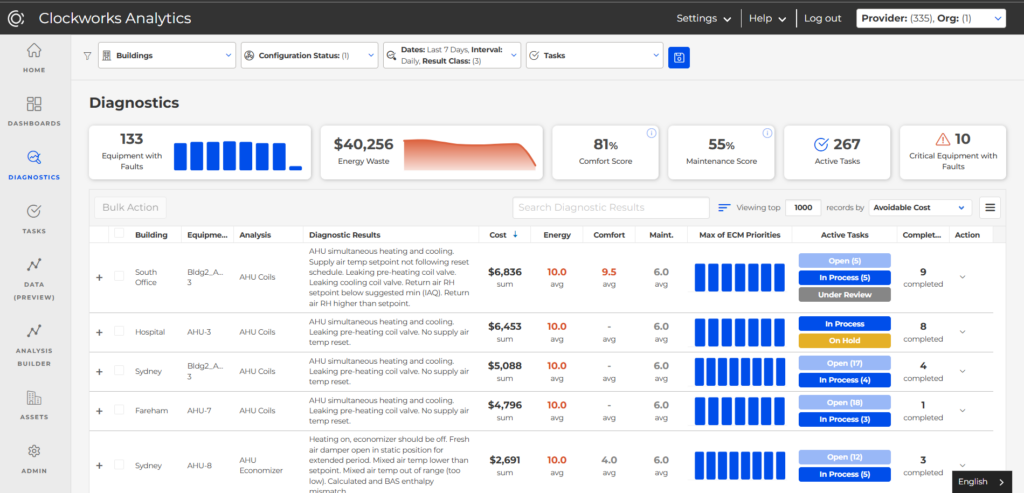
The question then shifts from “What can we afford to replace?” to something far more actionable: “What does the data show will fail next if we do nothing?” or “What does the data show will save the most money or energy.” That shift enables a fundamentally different approach to managing facilities.
FDD Supports Overstretched Teams Without Adding Headcount
Staffing constraints are a reality in K–12 facilities, with technicians often covering multiple schools and responding to constant alerts.
FDD helps teams focus on what matters most by automatically identifying and prioritizing critical issues. It reduces time spent chasing false alarms, preserves institutional knowledge in a digital record, and enables teams to work more efficiently—without adding headcount.
FDD Turns Deferred Maintenance into a Defensible Strategy
FDD brings transparency to deferred maintenance by turning it into something measurable and manageable. With clear visibility into system performance, districts can show what issues were identified, how risks were prioritized, and why decisions were made. This builds credibility with boards and communities, shifting deferred maintenance from a vague liability to a data-driven, defensible strategy.
FDD allows k-12 facility teams to:
- Catch issues early before they become failures
- Reduce emergency repairs and the chaos of reactive maintenance
- Protect learning environments by maintaining consistent temperature, comfort, and air quality
- Prioritize limited budgets based on actual equipment condition and risk
- Extend asset life by addressing problems before they cause permanent damage
- Lower energy waste by identifying inefficient system operation
- Support overstretched teams by focusing attention on the most critical issues
- Create defensible capital plans with data-backed justification for boards and stakeholders
- Preserve institutional knowledge in a system instead of relying solely on staff experience
- Improve transparency and accountability across facilities operations and decision-making
The Bottom Line
K–12 districts are not deferring maintenance because they don’t care. They are doing so because they lack the visibility needed to act with confidence and to prioritize a high volume of work orders.
Budgets will remain constrained, buildings will continue to age, and staffing challenges will persist. But with the right data—and the tools to turn that data into actionable insight—districts can move beyond reactive decision-making.
See What’s Possible with Clockworks’ FDD
School districts across the country are using FDD to identify issues earlier, reduce reactive work, and bring clarity to capital planning decisions.
Request a demo today to see how Clockworks helps K–12 facilities teams turn building data into action and make the shift to proactive maintenance.
Back to blog