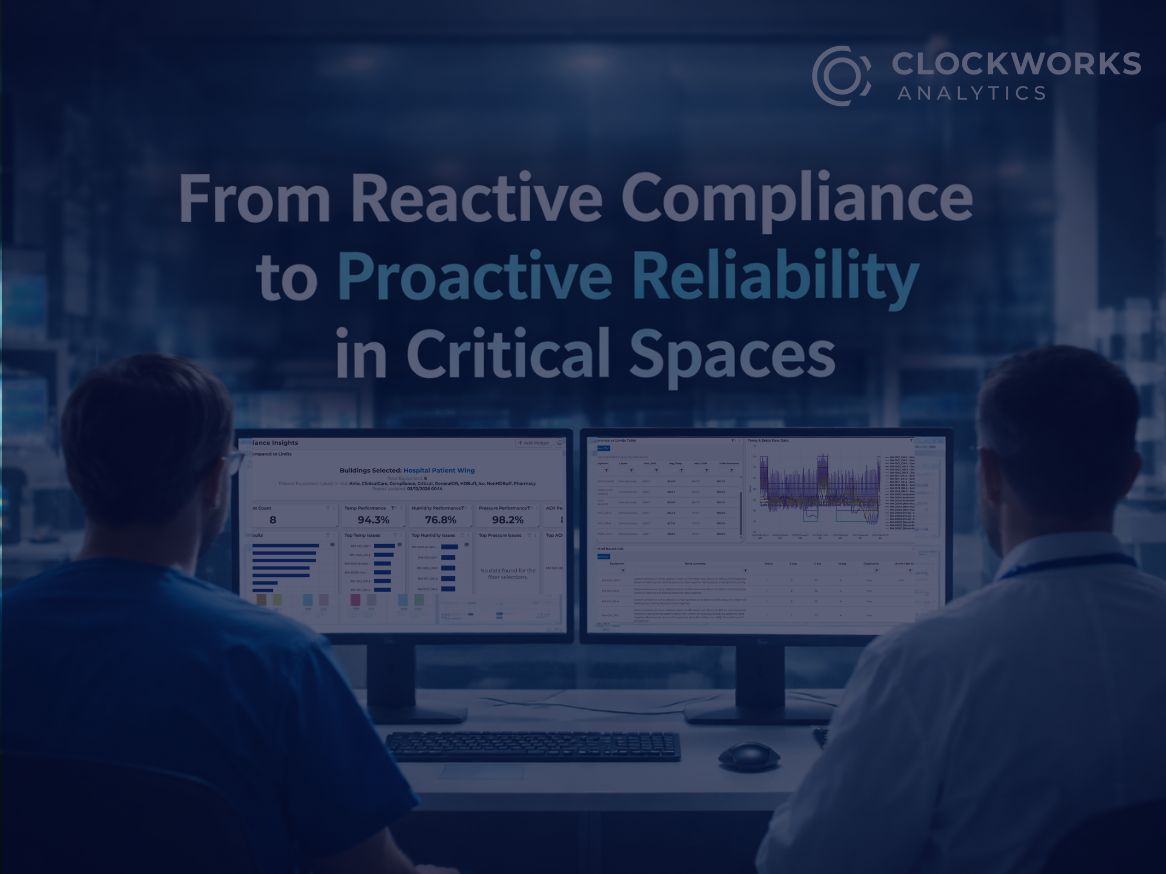
From Reactive Compliance to Proactive Reliability in Critical Spaces
March 24, 2026
For teams managing hospitals, labs, clean rooms, and other critical environments, compliance isn’t just a checkbox—it’s directly tied to safety, continuity, and trust.
Yet many organizations still rely on a mix of alarms, manual checks, and after-the-fact reporting. That approach may document what happened, but it rarely helps teams act early enough to prevent issues.
That’s where Fault Detection & Diagnostics (FDD) changes the equation.
In a recent webinar, Leslie Beu, Director of Program Management, explored how organizations are moving beyond reactive workflows toward proactive monitoring, simplified compliance, and faster root-cause identification.
The takeaway: better outcomes don’t come from more data—they come from turning data into usable intelligence.
Why critical spaces are so challenging
Critical environments aren’t like standard buildings. Temperature, humidity, and pressurization aren’t just metrics—they directly impact patient safety, product integrity, and research outcomes.
On top of that, compliance isn’t one-size-fits-all. Different facilities define excursions differently—by duration, thresholds, or internal policy. So it’s not enough to know something went out of range. Teams need to understand whether it truly violated compliance, how long it lasted, what caused it, and what action is required. That’s a far more complex challenge than simply generating alarms.
That’s a much bigger challenge than simply generating alarms.
From more alerts to better prioritization
There’s a common misconception that FDD is about surfacing more issues. In reality, its value lies in helping teams focus on the right ones.
In environments where resources are limited, analytics must do more than flag anomalies. They need to highlight the highest-risk issues, connect symptoms to root causes, and reduce time spent investigating. Instead of simply signaling that something is wrong, FDD helps teams understand what’s wrong, how severe it is, what’s causing it, and what to do next.
Turning data into action
Many teams today are surrounded by data but still lack clear direction. They have access to trends, alarms, and reports, yet struggle to answer fundamental questions about why issues occur, whether they are recurring, and where they originate.
FDD bridges that gap by connecting data across systems and prioritizing issues based on impact—not volume. This shift allows teams to move from reacting to problems toward proactively managing performance.
From compliance reporting to operational insight
One of the most impactful ideas from the webinar is that compliance and troubleshooting require different perspectives—but should stay connected.
Effective programs combine clear, audit-ready reporting with deeper operational insights that explain what happened and why. This creates a seamless path from reporting to diagnosis to resolution, enabling teams to both demonstrate compliance and continuously improve performance.
Closing the loop: from insight to action
FDD becomes even more powerful when integrated into existing workflows. When diagnostics connect directly to work order systems, teams can assign responsibility, track progress, and document resolution.
This is critical in regulated environments, where it’s not enough to detect an issue—organizations must also show how it was addressed. Connecting insight to action creates stronger accountability and a more complete operational record.
Beyond compliance
While compliance may be the starting point, the impact of this approach extends much further. Earlier detection and faster resolution lead to reduced downtime, better maintenance prioritization, improved asset health, and more efficient use of limited staff.
Ultimately, critical space monitoring shouldn’t be treated as a standalone reporting function. It should be part of a broader reliability strategy—one that enables teams to catch issues early, reduce risk, and build more resilient operations.
👉 Watch the full webinar to see how organizations are putting this into practice.
To provide the best experiences, we use technologies like cookies to store and/or access device information. Consenting to these technologies will allow us to process data such as browsing behavior or unique IDs on this site. Not consenting or withdrawing consent, may adversely affect certain features and functions.
Functional
Always active
The technical storage or access is strictly necessary for the legitimate purpose of enabling the use of a specific service explicitly requested by the subscriber or user, or for the sole purpose of carrying out the transmission of a communication over an electronic communications network.
Preferences
The technical storage or access is necessary for the legitimate purpose of storing preferences that are not requested by the subscriber or user.
Statistics
The technical storage or access that is used exclusively for statistical purposes.The technical storage or access that is used exclusively for anonymous statistical purposes. Without a subpoena, voluntary compliance on the part of your Internet Service Provider, or additional records from a third party, information stored or retrieved for this purpose alone cannot usually be used to identify you.
Marketing
The technical storage or access is required to create user profiles to send advertising, or to track the user on a website or across several websites for similar marketing purposes.
To provide the best experiences, we use technologies like cookies to store and/or access device information. Consenting to these technologies will allow us to process data such as browsing behavior or unique IDs on this site. Not consenting or withdrawing consent, may adversely affect certain features and functions.
Functional
Always active
The technical storage or access is strictly necessary for the legitimate purpose of enabling the use of a specific service explicitly requested by the subscriber or user, or for the sole purpose of carrying out the transmission of a communication over an electronic communications network.
Preferences
The technical storage or access is necessary for the legitimate purpose of storing preferences that are not requested by the subscriber or user.
Statistics
The technical storage or access that is used exclusively for statistical purposes.The technical storage or access that is used exclusively for anonymous statistical purposes. Without a subpoena, voluntary compliance on the part of your Internet Service Provider, or additional records from a third party, information stored or retrieved for this purpose alone cannot usually be used to identify you.
Marketing
The technical storage or access is required to create user profiles to send advertising, or to track the user on a website or across several websites for similar marketing purposes.