

From Reactive Compliance to Proactive Reliability in Critical Spaces
March 23, 2026
For organizations managing hospitals, pharmacies, clean rooms, labs, research environments, and other critical spaces, compliance is never just a reporting exercise. It is deeply tied to safety, continuity, trust, and operational performance.
The challenge is that most teams are still trying to manage critical environments with a patchwork of alarms, manual checks, trend reviews, and after-the-fact reporting. That approach may document what happened, but it rarely helps teams intervene early enough to prevent issues from becoming bigger risks.
That is where Fault Detection and Diagnostics (FDD) changes the equation.
In a recent Clockworks webinar, Leslie Beu, Director of Program Management at Clockworks Analytics, explored how organizations are using FDD to move beyond raw data and reactive workflows toward proactive monitoring, simplified compliance reporting, and earlier identification of the root causes behind performance issues.
The core message was clear: in critical spaces, better outcomes do not come from having more data. They come from turning data into usable intelligence.
Why critical spaces are uniquely hard to manage
Critical environments are more complex than standard commercial spaces because the stakes are higher, and the requirements are more specific. Temperature, humidity, pressurization, and air changes are not just operational metrics. In many settings, they are directly tied to patient safety, pharmaceutical integrity, research quality, regulatory compliance, or preservation of valuable assets.
These environments also come with an added layer of operational complexity. Different facilities may follow different standards, different versions of those standards, and different internal policies that define what counts as a true compliance event. One organization may define an excursion after fifteen minutes. Another may allow an hour. Another may require every interval to stay within range.
That variability is one reason compliance in critical spaces has traditionally been difficult to operationalize through analytics alone. It is not enough to know that a value drifted outside a threshold. Teams need to know whether it crossed a regulatory limit, whether it violated internal policy, how long it lasted, what caused it, who needs to be notified, and what action was taken.
That is a much bigger challenge than simply generating alarms.
FDD drives prioritization in critical environments
There is often a misconception that FDD is just about surfacing more faults. In reality, the value of FDD is not generating more alerts. It is in reducing the time teams spend searching for, validating, and interpreting problems so they can spend more time fixing the right ones.
That distinction matters.
Facilities teams today are being asked to do more with fewer people. Skilled staff are retiring. Budgets are constrained. Many organizations are facing aging infrastructure, rising performance expectations, and a constant need to justify investment. In that environment, a useful analytics platform must do more than flag anomalies. It has to help prioritize what matters most and point users toward likely root causes.
That is where a strong FDD platform becomes operationally meaningful. It provides root-cause diagnostics—helping teams move from “something looks wrong” to “here is what is likely wrong, how severe it is, what systems are related, and what action should happen next.”
Building analytics that drive action
One of the biggest pain points in critical environments is that teams are often overwhelmed by data but under-supported in action. They may have access to trend logs, alarms, BMS data, and manual reports, but still struggle with the questions that matter most:
Why did this happen? How serious is it? Is this a one-off event or a recurring pattern? Is the issue in the room, the controller logic, or the upstream equipment? Do we need to escalate this as a compliance issue? What should we do first?
Without a system that can connect those dots, even valid faults can pile up faster than teams can respond. And when hundreds of issues appear in a day, prioritization becomes the real problem.
For critical spaces, that prioritization cannot be based on volume alone. It has to account for impact, risk, operational context, cost, and the likelihood that one upstream issue may be driving multiple downstream symptoms.
What Clockworks is doing differently
Clockworks approaches this challenge with a cloud-based, FDD platform that connects to the building automation system, models equipment and system behavior, and produces root-cause diagnostics based on over 20 years of expert-system AI. Once the analytics are running, Clockworks is monitoring every system and piece of equipment in real-time, continuously, and across all buildings and campuses.
All this data runs through the analytics engine, and the highest-impact issues are prioritized and presented to the team.
Instead of simply showing that a room is out of compliance, the platform helps users understand whether the issue is tied to a controls problem, a setpoint configuration issue, a sensor problem, a piece of mechanical equipment, or an upstream relationship affecting multiple spaces.
In the webinar, Leslie showed how the platform supports this through a suite of Critical Space Dashboards designed for different users and different needs.
Compliance & Critical Space Monitoring Dashboards
Clinical teams, pharmacy staff, compliance leaders, and regulatory stakeholders often need a clear reporting view that answers a simple question: were these spaces compliant over the required period?
Facilities and engineering teams, on the other hand, need something very different. They need to see patterns, deviations, equipment relationships, fault severity, and likely root causes so they can troubleshoot and resolve issues quickly.
Clockworks addresses this with a three-part approach:
Compliance reporting dashboards provide a clean view of compliance status over defined periods such as the last 24 hours, 7 days, or 30 days. These dashboards are built for communication, reporting, and audit support.
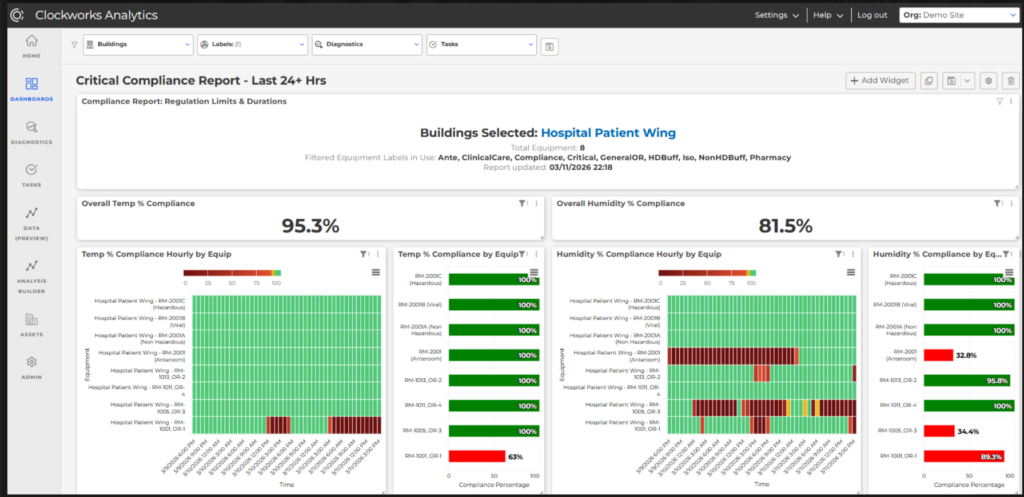
Compliance insights dashboards go deeper, helping teams identify what happened behind a compliance event, when it occurred, how severe it was, and what equipment or control logic may be involved.
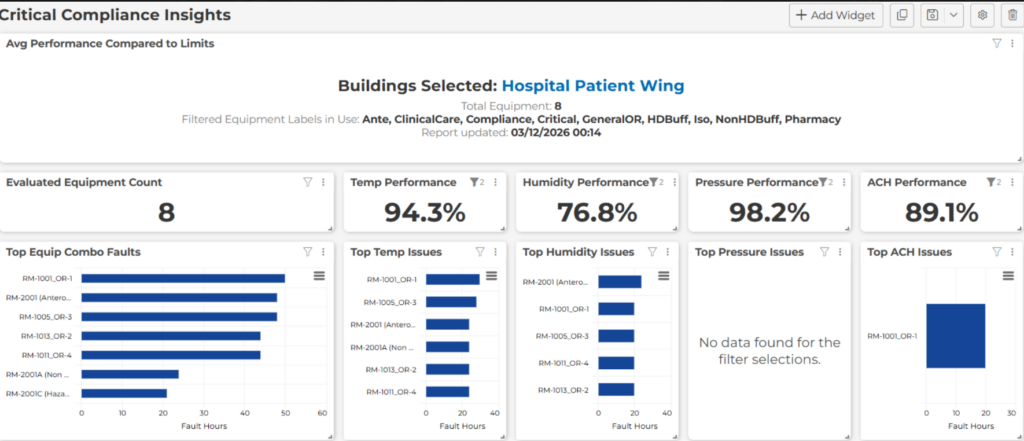
Critical space insights dashboards support environments that may not have formal regulatory requirements but still need tight environmental control. These views compare actual performance to operational setpoints and make it easier to identify nuanced issues before they escalate.
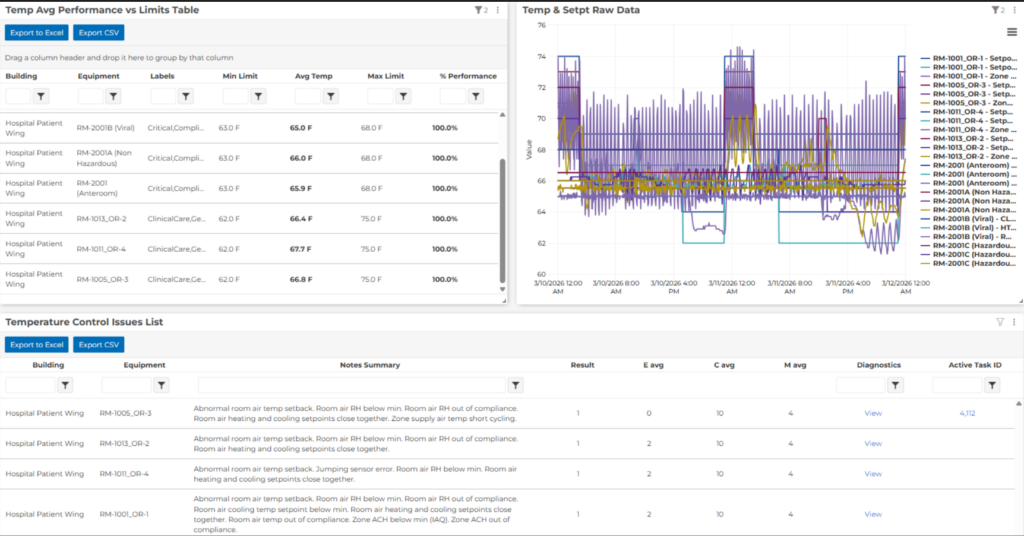
This layered approach is important because it separates reporting from troubleshooting without disconnecting the two.
Compliance reporting demands flexible system support
A particularly important point from the webinar was that compliance in real facilities depends not only on regulatory thresholds, but also on how each organization defines and manages excursions.
That includes factors like:
- How long a variable must be out of range before it counts as non-compliant
- Which standard or standard version applies
- What notifications must occur
- How corrective action is documented
- How different internal stakeholders need to see the information
Clockworks has built flexibility into the system to support these policy differences without turning implementation into a heavy customization exercise. Organizations can configure thresholds, durations, and reporting logic to align with their own requirements, whether they are following ASHRAE 170, pharmacy-related standards, or internal critical environment policies.
Turning FDD insights into action
FDD helps users move from symptom to cause faster in three key ways:
Pinpointing root-causes
For example, a room temperature issue may initially look like a simple compliance deviation. But once the user drills down, the system may reveal that the room’s cooling setpoint has been configured below the acceptable minimum. Instead of sending the team on a long mechanical investigation, the diagnostics point them toward a controls or programming issue immediately.
That is a very different experience from manually reviewing raw trends and trying to infer what happened.
Reducing alarm fatigue
FDD also helps users see patterns across multiple rooms or pieces of equipment. If several spaces served by the same air handler begin showing similar symptoms, the system can help expose that relationship. Likewise, if multiple rooms share the same controls logic issue, the diagnostics can suggest that the root problem is broader than a single room excursion. Being able to dynamically provide prioritizations that recognize that multiple issues are all symptoms of the same problem is key to reducing alarm fatigue.
Workflow improvements
Things start to get really exciting once FDD is integrated with an existing CMMS or work order system. Users can create tasks directly from a diagnostic, assign responsibility, tag the issue appropriately, and track the resolution process. This integration ensures the operational workflow remains aligned with the tools teams already use.
This matters for compliance because it helps close the loop.
Auditors and regulators do not just want to know that a deviation occurred. They want to know what was done about it, how quickly it was addressed, and whether the issue was resolved. Connecting diagnostics to action creates a more complete operational record and supports stronger accountability across teams.
Beyond compliance
Although the webinar focused on compliance and critical space monitoring, the value proposition of FDD is much bigger. The same capabilities that help teams detect excursions earlier and troubleshoot them faster also support:
- better maintenance prioritization
- reduced downtime and fewer breakdowns
- stronger asset health visibility
- more informed capital planning
- better use of limited staff time
- improved confidence across operational stakeholders
In other words, critical space monitoring should not be viewed as a standalone reporting function. It should be part of a larger reliability strategy.
When teams can identify subtle performance degradation before it becomes a compliance problem, they are not just staying within limits. They are protecting equipment life, reducing emergency response, and building a more resilient operation.
Back to resourcesRelated Posts
- [CASE STUDY] Hudson Pacific Avoids State Penalties with Smart FDD Strategy
- [NEXUSLABS] Clockworks Bet Early on Tech-Enabled Services — Partners Channel is Now Proven Model for Scaling FDD Beyond Owner-Staffed Campuses
- [NEXUSLABS] MacDonald Miller’s FDD Pivot: From Custom Rules to a Buy-Not-Build Strategy