

How to Build a Sustainable FDD Program: 5 Steps That Work
August 10, 2026
TL;DR
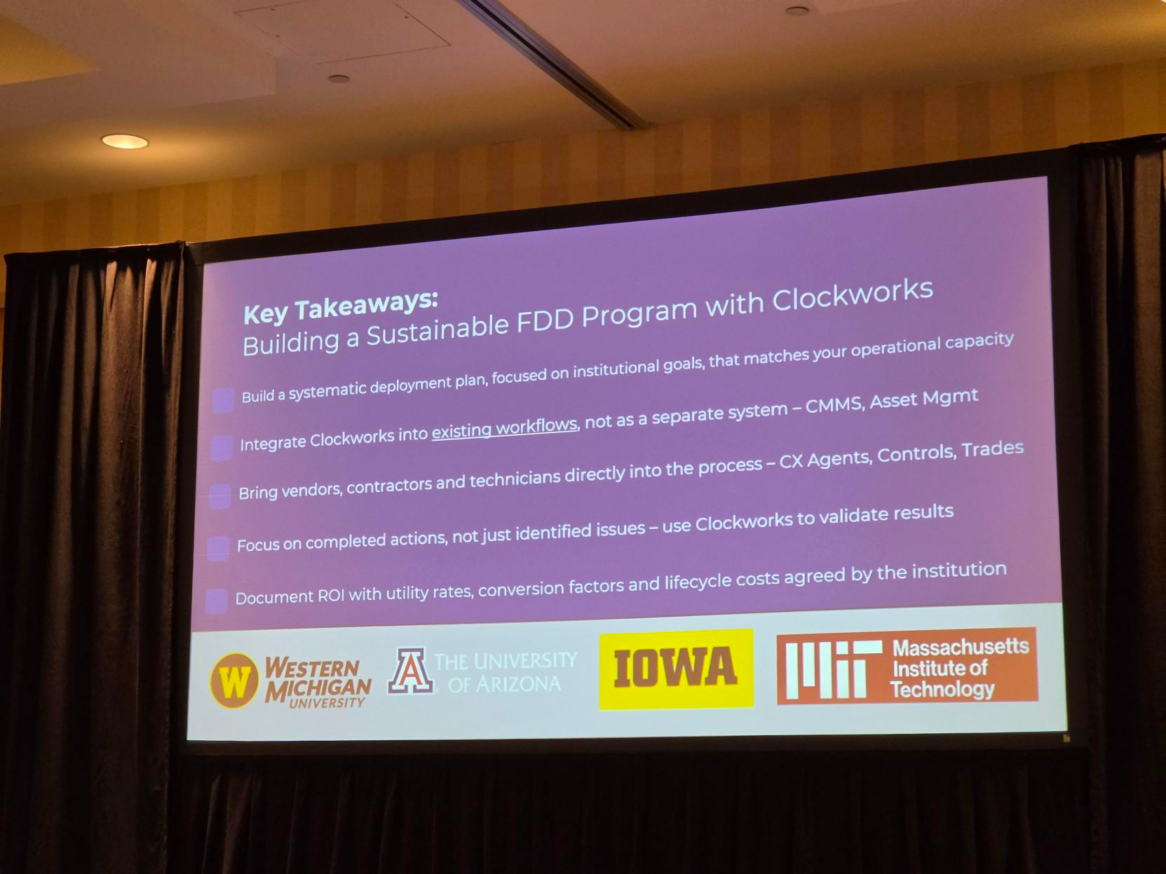
To build a sustainable fault detection and diagnostics (FDD) program, do five things:
- Match your rollout to your team’s capacity.
- Build FDD into the workflows you already use.
- Bring vendors and contractors in from the start.
- Fix problems — don’t just find them.
- Prove the savings with real utility rates.
Do these five things, and building data turns into real money saved. The University of Iowa used this approach to save $2.5 million a year.
Most buildings waste energy every day. Bad settings, broken parts, and small faults add up fast. The trouble is, these problems are hard to see. They hide inside complex systems.
Fault detection and diagnostics (FDD) fixes that. FDD is software that watches your building systems around the clock. It finds problems on its own. Then it tells your team what is wrong and what to do.
But buying FDD software is not enough. Many teams turn it on, get excited, and then lose steam. The alerts pile up. Nothing gets fixed. The savings never show up.
A sustainable FDD program is different. It keeps working year after year. It fits how your team already works. And it proves its value in dollars.
We monitor more than 660,000 pieces of equipment and 5.8 million data points across 4,300 buildings. Those buildings have driven nearly 70,000 tasks to completion and over $85 million in annual cost savings. Here are the five steps we see behind the programs that last.
1. Match your plan to your team’s capacity
Start with the buildings that matter most. Do not try to do everything at once.
A common mistake is going too big, too fast. A team connects dozens of buildings on day one. Then the alerts flood in. No one has time to act. The program stalls.
The fix is simple. Start small. Pick a few high-priority buildings. Learn what works. Then add more as your team is ready.
This is how strong programs grow. They scale at a pace the team can handle. Each new building adds more savings without breaking the workflow.
2. Build FDD into the workflows you already use
FDD should not be a separate system your team logs into once a week. It should live inside the tools they use every day.
Connect FDD to your maintenance workflow. Turn findings into work orders. Feed them into your CMMS or asset management system. That way, fixing a fault is just part of the normal job.
This is the single biggest success factor. When FDD is bolted on the side, it gets ignored. When it is built in, it sticks.
3. Bring vendors and contractors in from the start
Your team is not the only group that touches your buildings. Commissioning agents, controls vendors, and trade contractors all play a role.
Give them access to the platform. Bring them into the process early. Let them see the same data your team sees.
Some schools go further. They write FDD into their construction contracts and RFPs. New buildings must use the platform during commissioning. This builds accountability from day one. It also catches problems before a building even opens.
Shared data becomes a shared language. Everyone works from the same facts.
4. Fix problems — don’t just find them
FDD is very good at finding faults. But a fault that is found saves nothing. Only a fault that is fixed saves money.
This sounds obvious. It is easy to miss. Many teams get proud of long lists of issues. They track how many problems they spot. But the real goal is completed action.
So measure what gets resolved, not just what gets flagged. Build a review process. Assign owners. Follow up until the work is done. Then use FDD to confirm the fix actually worked.
5. Prove the savings with real utility rates
The last step earns you trust and budget. You have to show the money.
Use your own utility rates, not general estimates. If your campus runs its own power plant, your rates may be lower than the grid. Real rates give you real numbers.
Then track the cost of waiting. Every day a fault goes unfixed, it wastes energy and money. Putting a dollar figure on that helps your finance team say yes.
Accurate ROI data builds credibility. It turns your FDD program from a cost into an investment.
What does a sustainable FDD program deliver?
These five steps are not theory. They produce real, lasting results.
The University of Iowa is a clear example. Iowa built its FDD program the right way. The team tied it into daily maintenance work. They trained their HVAC technicians with it. They did not treat it as an energy tool alone.
The results speak for themselves:
- $2.5 million in verified energy savings each year
- $600,000 found in just the first six months
- 47 buildings and 6.9 million square feet covered
- 2,100 tasks driven to completion
In 2018, the U.S. Department of Energy and Lawrence Berkeley National Laboratory recognized the Iowa team for this work.
The research backs this up too. One landmark study looked at nearly 1,500 buildings. It found that monitoring-based commissioning delivers about 9% in median energy savings. That is the ongoing approach FDD makes possible. Few upgrades pay off that fast.
The bottom line
Fault detection and diagnostics can transform how you run your buildings. But the software is only part of the story. The program around it is what makes the savings last.
Match your plan to your team. Build FDD into daily work. Bring in your vendors. Fix what you find. And prove the value with real data.
Do that, and you will have an FDD program that keeps paying off for years.
Ready to build your program?
Want to talk it through? Connect with our team — Clockworks Analytics builds the best automated building analytics in the industry.
Frequently Asked Questions
What is a sustainable FDD program?
A sustainable FDD program is a fault detection and diagnostics effort that keeps delivering value year after year. It fits your team’s capacity, connects to your daily workflows, involves your vendors, focuses on fixing issues, and proves its savings with real data.
What is fault detection and diagnostics (FDD)?
Fault detection and diagnostics (FDD) is software that monitors building systems automatically. It finds faults and inefficiencies, explains what is wrong, and helps teams fix problems before they get costly.
How much money can an FDD program save?
Savings vary by building, but the results can be large. The University of Iowa saves about $2.5 million a year. Research on nearly 1,500 buildings shows monitoring-based commissioning delivers around 9% median energy savings.
Is FDD the same as a building alarm?
No. An alarm means something is critically wrong and needs action right now. An FDD diagnostic means something is inefficient or drifting and should be fixed on a planned schedule. Think of it like a check-engine light, not a fire alarm.
How long does it take to see ROI from FDD?
Many teams see savings quickly. The University of Iowa found $600,000 in savings within the first six months. Ongoing commissioning approaches often pay back in under two years.