

Reshaping Facilities Maintenance and Asset Management in Higher Education with Data, Analytics, and AI
June 12, 2026
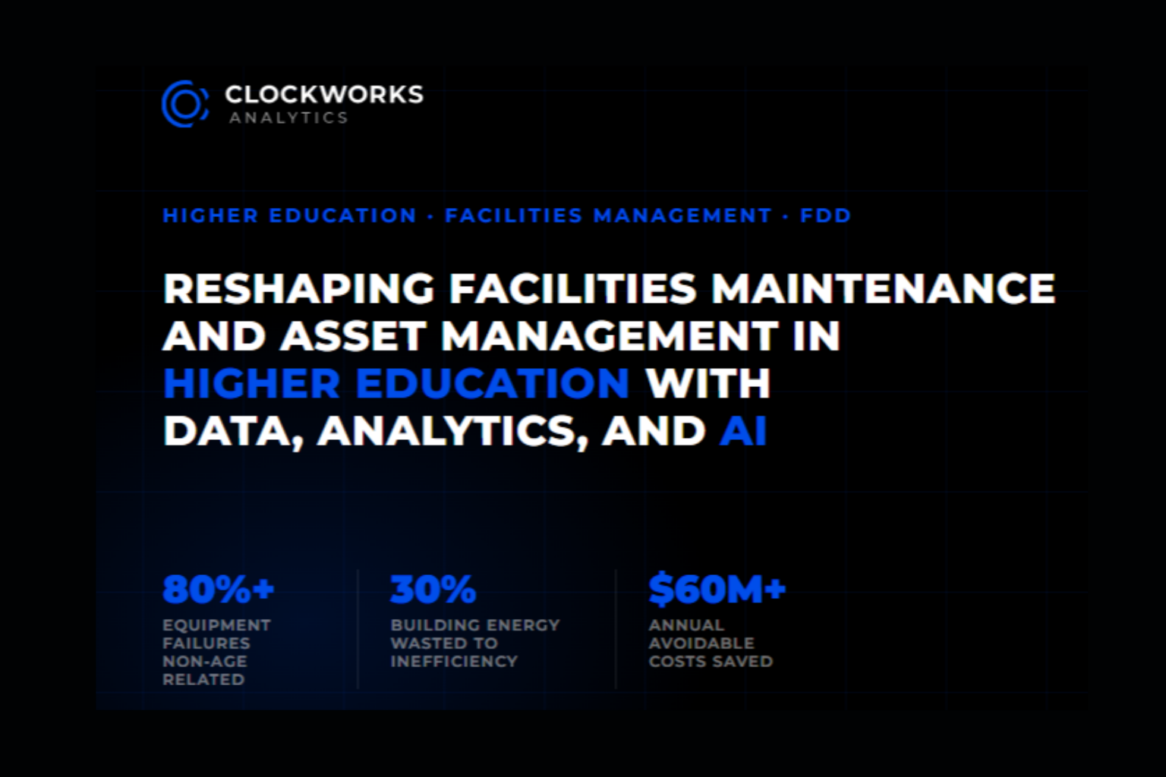
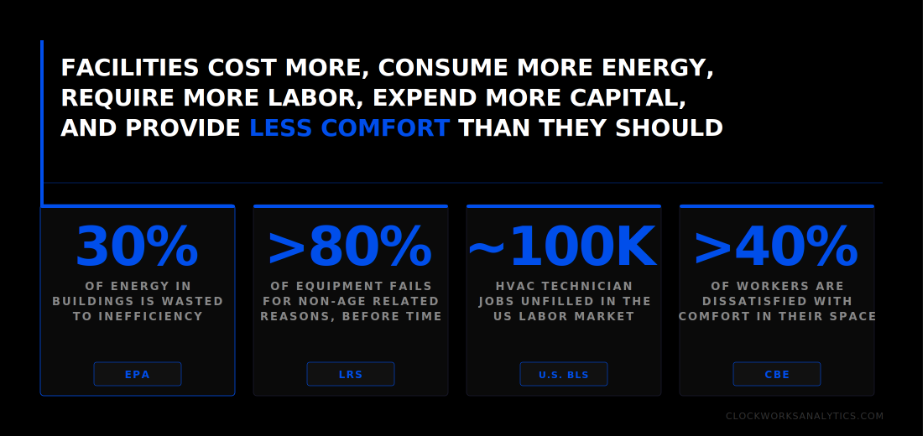
Higher education facilities teams are under pressure from every direction. Equipment is failing, energy is being wasted at scale, skilled labor is increasingly hard to find, and occupants are still not comfortable in their spaces. The data paints a stark picture: more than 80% of equipment failures are non-age related, 30% of building energy is wasted to inefficiency, and over 40% of workers are dissatisfied with comfort in their workspace — all while roughly 100,000 HVAC technician jobs go unfilled across the US.
The conclusion is hard to argue with: facilities cost more, consume more energy, require more labor, expend more capital, and provide less comfort than they should.
So, what changes that?
The Foundation: A System of Record for Asset Health
The answer isn’t more alarms or more checklists. It’s a smarter foundation — one built on continuous data, automated diagnostics, and AI-powered analysis that gives facilities teams the insight to act on what matters most.
That foundation is condition-based facilities management, enabled by Fault Detection and Diagnostics (FDD).
Clockworks Analytics connects directly to a building’s BMS through a read-only software gateway, polling data every five minutes from virtually any protocol or controls platform — BACnet, Siemens, Honeywell, Schneider Electric, Johnson Controls, and more. That data feeds into a global analysis engine that models equipment behavior, infers operating relationships, and runs over 50 physics-based expert system analyses — continuously, across every connected building.
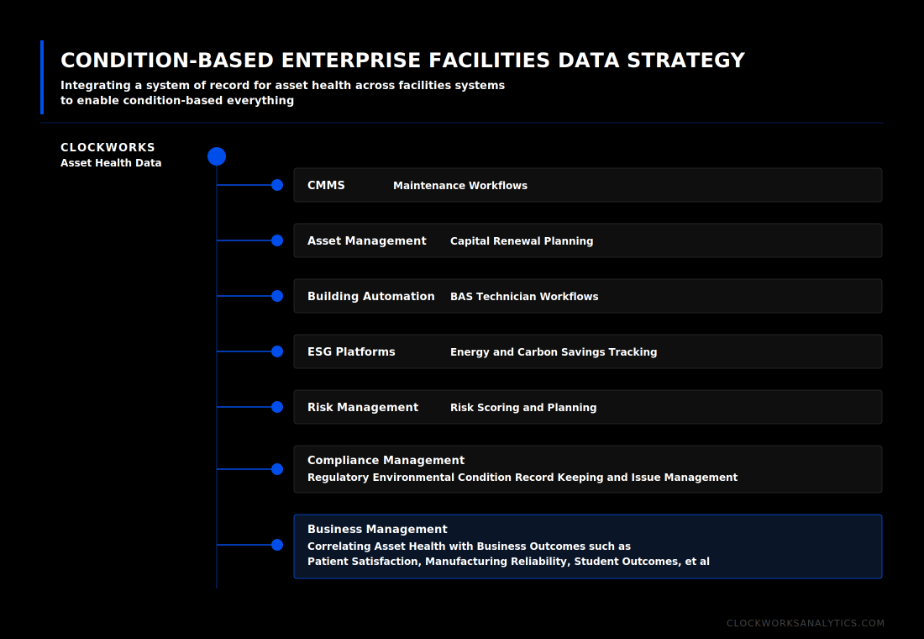
The result is a living system of record for asset health: not just alarms, not just fault flags, but root cause statements, energy cost impacts, maintenance priorities, and recommended corrective actions — all scored and ranked so teams can act on the highest-impact work first.
Today, that engine monitors 3,500+ buildings globally, has supported completion of 60,000+ maintenance tasks, and saves clients over $60 million in avoidable costs every year.
Understanding the AI Stack
There’s a lot of noise around AI in buildings right now. Before going further, it’s worth being precise about what different technologies actually do.
Artificial Intelligence (AI) is the broad category — any technology enabling a machine to simulate human behavior like problem solving. Within that:
- Expert Systems (ES) use a knowledge base to apply physics-based logic to complex problems within a specific domain. This is the core of what powers Clockworks diagnostics.
- Machine Learning (ML) uses statistical algorithms to learn patterns in data without explicit human programming.
- Deep Learning (DL) is a subset of ML that filters data through multiple model layers.
- Large Language Models (LLM) are deep learning models trained on massive text corpora to predict and generate language.
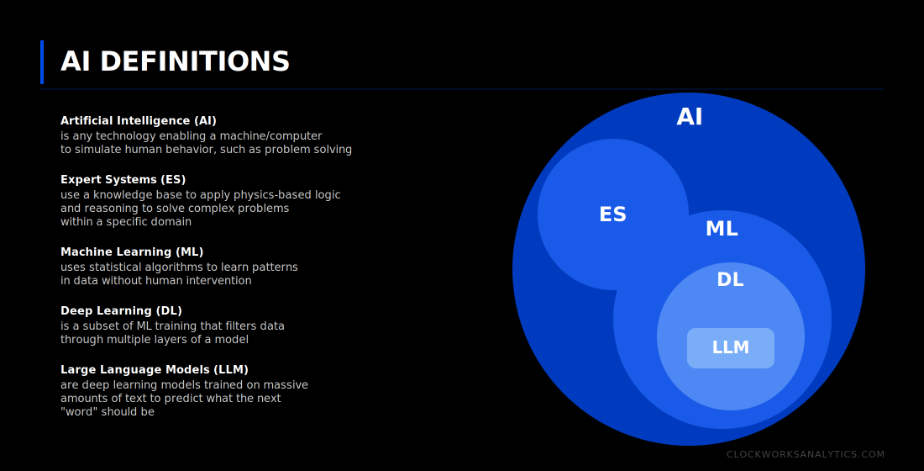
Clockworks uses a combination of these — expert systems for diagnostics, ML for asset inference, and LLMs for document parsing and orchestrated workflows — but when accuracy and reliability matter most, expert systems do the heavy lifting. Physics-based logic doesn’t guess.
Why FDD Goes Further Than Alarms
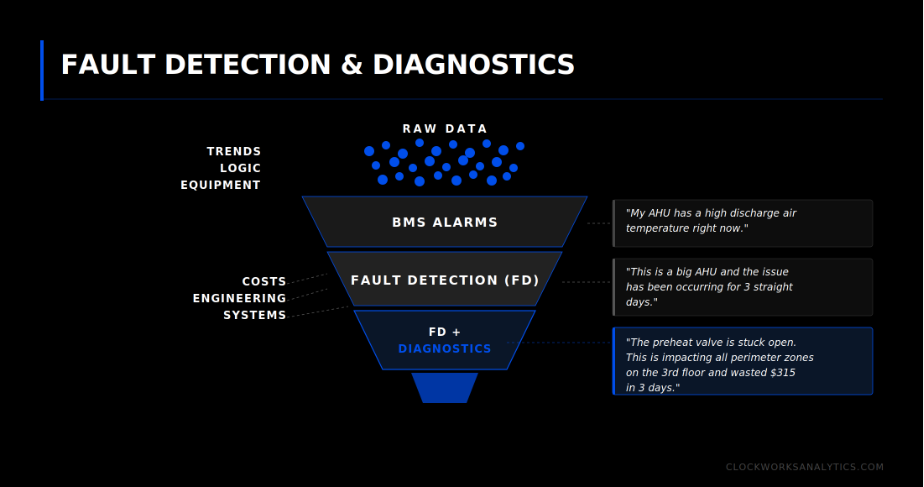
Most facilities teams are familiar with BMS alarms. An AHU discharge air temp climbs above setpoint, an alarm fires, a technician is dispatched. The problem: alarms tell you *that* something is wrong. They don’t tell you *why*, for *how long*, *how much it’s costing*, or *what else might be wrong on that same piece of equipment*.
That gap is where FDD changes the equation.
Consider the same high discharge air temp scenario through three lenses:
- With a BMS alarm only: A technician sees a flag, goes to investigate, and still has to diagnose the root cause manually — often leading to repeat visits, incorrect first fixes, and continued energy waste.
- With fault detection: The platform identifies that the fan HP is elevated, the mixed air temp sensor appears to have an error, and the economizer isn’t utilizing free cooling — giving the technician a clearer starting point.
- With full FDD diagnostics: The system identifies that the preheat valve is stuck open, quantifies the energy cost impact at $300 per day, flags the co-occurring issues on the same unit, and generates a recommended corrective action — all before the technician sets foot in the mechanical room.
That last scenario isn’t aspirational. It’s what condition-based maintenance looks like in practice.
The Condition-Based Maintenance Journey
Condition-based maintenance isn’t an all-or-nothing transformation. It’s a progression and facilities teams can start extracting value immediately, regardless of where they are today.
Level 1: Highest Impact Work
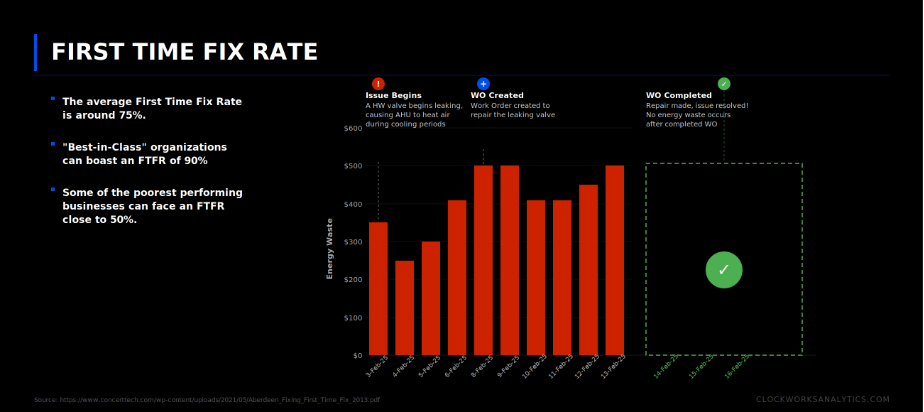
Use FDD diagnostics to pinpoint root causes, prioritize the highest-impact reactive work, measure success, and confirm repairs actually resolved the issue. This alone dramatically improves first time fix rates — a metric that has outsized impact on labor efficiency. Industry data shows average first-time fix rates around 75%; best-in-class organizations reach 90%. For a team completing 1,000 work orders per year, the difference between 50% and 90% FTFR translates to 800 hours of labor that can be redirected to proactive work.
Level 2: Enhanced Preventive Maintenance
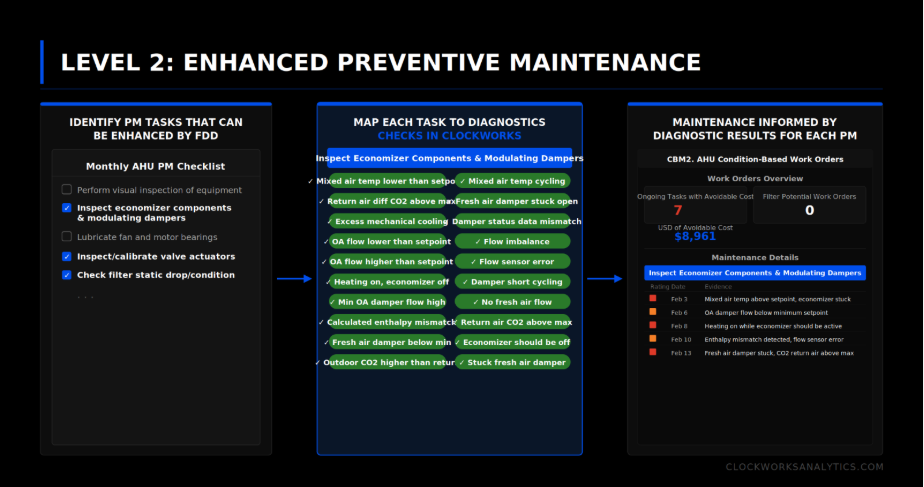
Map existing PM checklist tasks to FDD diagnostic checks in Clockworks. Instead of inspecting economizer components on a quarterly schedule regardless of condition, technicians arrive informed by the platform’s continuous monitoring — knowing in advance which components have flagged issues and what the data shows. ASHRAE 180 compliance requires roughly 955 PM checklists per year for a typical building. Clockworks runs more than 4,000 automated checks every single day on the same building portfolio. That’s not a replacement for PM — it’s a force multiplier.
Level 3: Data-Driven Facilities Management
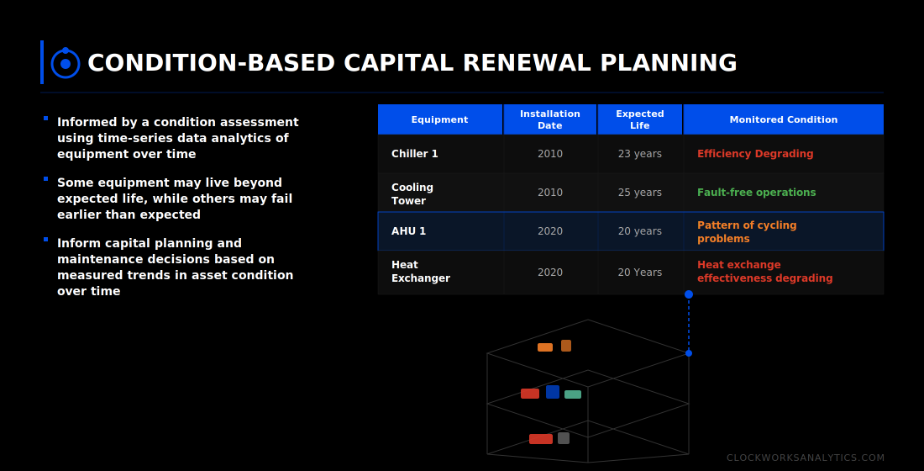
At full maturity, condition-based maintenance enhances capital planning, informs renewal decisions based on measured asset degradation rather than installation date alone, and integrates asset health data across CMMS, ESG platforms, risk management, and business outcomes tracking. An equipment’s age tells you very little. Its measured condition tells you everything.
Clockworks Analytics empowers facilities teams across 3,500+ buildings worldwide to reduce energy waste, improve equipment reliability, and operate smarter. Learn more at (https://clockworksanalytics.com).
Back to blog